Through leadership, advocacy, normative guidance and technical support, the Joint Programme provided support to strengthen access to innovative targeted combination HIV prevention interventions in 2025. The Joint Programme focused on safeguarding prevention as a strategic priority within national agendas, helping countries maintain progress towards the 2030 HIV prevention targets despite the unprecedented financial shifts in 2025.
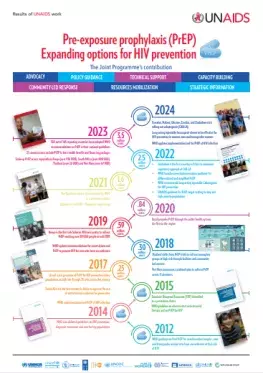
Catalytic support from the Joint Programme enabled the continued scale-up of diversified prevention options and new technologies. By January 2025, 94% of reporting countries had adopted WHO PrEP recommendations, including long-acting cabotegravir in 21 countries and the dapivirine ring in 18 countries. Following the publication of guidelines on the use of lenacapavir for HIV prevention and testing strategies, WHO provided support to 14 countries to accelerate lenacapavir roll-out. By end of 2025, 12 regulatory agencies had approved lenacapavir for HIV prevention, and two countries (Eswatini and Zambia) had begun programmatic delivery. In Latin America and the Caribbean, access to PrEP was expanded to transgender women in 19 countries, and the PrEP Without Borders initiative reached 1200 transgender women across Chile, the Dominican Republic, Ecuador and Honduras through community-led prevention workshops.
Condom programming was sustained through advancing last-mile distribution approaches. UNFPA procured 1.2 billion condoms globally, contributing to the prevention of an estimated 5.1 million sexually transmitted infections and over 118 000 HIV infections. The endorsement of national condom strategies and creation of community condom distribution points increased condom access and use in several countries in eastern and southern Africa. The Joint Programme provided support to further strengthen voluntary medical male circumcision programmes. UNHCR's refugee health operations delivered services to over 5700 men across eight African countries. Gender-transformative initiatives, including UN Women's HeForShe campaign, reached over 120 000 women and men in South Africa, promoting HIV testing and linkage to services.
The Global HIV Prevention Coalition (GPC) Secretariat, co-convened by UNFPA and the UNAIDS Secretariat, deployed a simplified prioritisation and cost-effectiveness package to support national reprogramming discussions towards high-impact HIV prevention interventions. The Joint Programme provided direct support to countries to advance national HIV prevention roadmaps, such as in Ghana, Mozambique, the United Republic of Tanzania and Zambia. In addition, sub-national scorecards were operationalised to support district-level performance monitoring and prevention indicators were integrated into national monitoring platforms to strengthen accountability for prevention outcomes.
The Joint Programme continued to reinforce and expand targeted prevention for key and other vulnerable populations through integrated service delivery, provider capacity building, high level advocacy, and policy and programme strengthening. Updated guidance on Trusted Access Platforms provided operational models for sustaining community-led prevention services for key populations through community-led, clinic-linked and digital platforms. Through Joint Programme support and leadership, adoption and implementation of opioid agonist maintenance therapy policies and harm reduction strategies advanced in several regions. Through UNODC’s targeted support, emergency methadone procurement prevented treatment interruption in Egypt, services were restored to over 700 clients in Afghanistan, and Indonesia piloted a community-based harm reduction model. Institutional capacity in infection prevention and control, gender-responsive services and post-release coordination was also strengthened through UNODC support, via the training of over 1300 prison, probation and health personnel across 12 countries.